In Praise of the Public Domain (or, more AI-adjacent thoughts)
Boo for Sonny Bono
My nonfiction book proposal course starts soon! Learn more about it here.
Last week’s newsletter about blowing deadlines is here.
I am spending more and more time with the public domain. I hang out there to find new titles for our Belt Revivals series, and for the American Made book I’m editing (and publishing) next summer. Phoebe and I are working on a new edition of The Battle of Lincoln Park that will include photos, so we’re scouring for public domain images we might use.
What is the public domain? Well, for the purposes of this newsletter, it’s anything that is free, because free from copyright restrictions. For books published in the United States, that more or less means published before 1930. For works published after that, it means someone has decided to let anyone access and use it: works created by the US government are copyright-free, thus American Made is based on Library of Congress-digitized material available to all. Some writers, photographers, artists, etc. voluntarily choose to allow their works to be free of restrictions, thus hopefully some 1960s photos of Chicago. Every fall I hang out in this Reddit forum to find out what’s going to be available the subsequent year.
Sounds pretty great, right? Information and art that is free to all, to enable access to knowledge, innovation, creativity without a paywall or restrictions. Creating a robust public domain was the primary concern of the founders, whose Constitution allowed only a maximum copyright term of 14 years. Jefferson thought there should be no copyright at all: he considered it a monopoly, which he opposed across the board, and did not think it took away from one creator to allow others access to their works. The others considered copyright a tax that the public should pay—but not for very long.
[This is where I originally put a paywall until I realized that would kinda hypocritical! But go ahead and voluntarily subscribe]
Since then copyright laws have stretched that initial 14 year term to almost a century, locking so much great stuff up. Now, many authors who object to AI use copyright to bolster their case, thereby endorsing restrictions, high fences, and all sorts of actions that might otherwise be considered politically anathema: they assert a monopolistic, individualistic, proprietary stance towards their books. (They may not be wrong! I’m simply explaining). Strangely seemingly lost in the discourse is the Creative Commons, a sensible way to thread the current needle. Why not copyright laws but weaker ones? Why default to asserting the strongest possible interpretation? After all, it’s Disney and Marvel that most benefit from strong copyright laws, not the midlist author whose 2010 book has sold three copies this decade (that’s me, I’m that author. You want to put A Skeptic’s Guide To Writers’ Houses up on the web for free? Go ahead! (Sorry, Penn Press)). And Sonny Bono has a lot to answer for.
The more I hear authors outraged at their copyright being abridged (“get off my lawn!”) the more fondly I tilt towards the beauty of the public domain. I am a huge fan of the Public Domain Review. I flirt with publishing more and more underknown works found in this vast resource: it seems to me that would be meaningful and worthy work, as I’m always astonished at how superficial is the scraping of past works brushed off for current audiences. There is so much more than the minor works by major authors there Extraordinary work is just a click away.
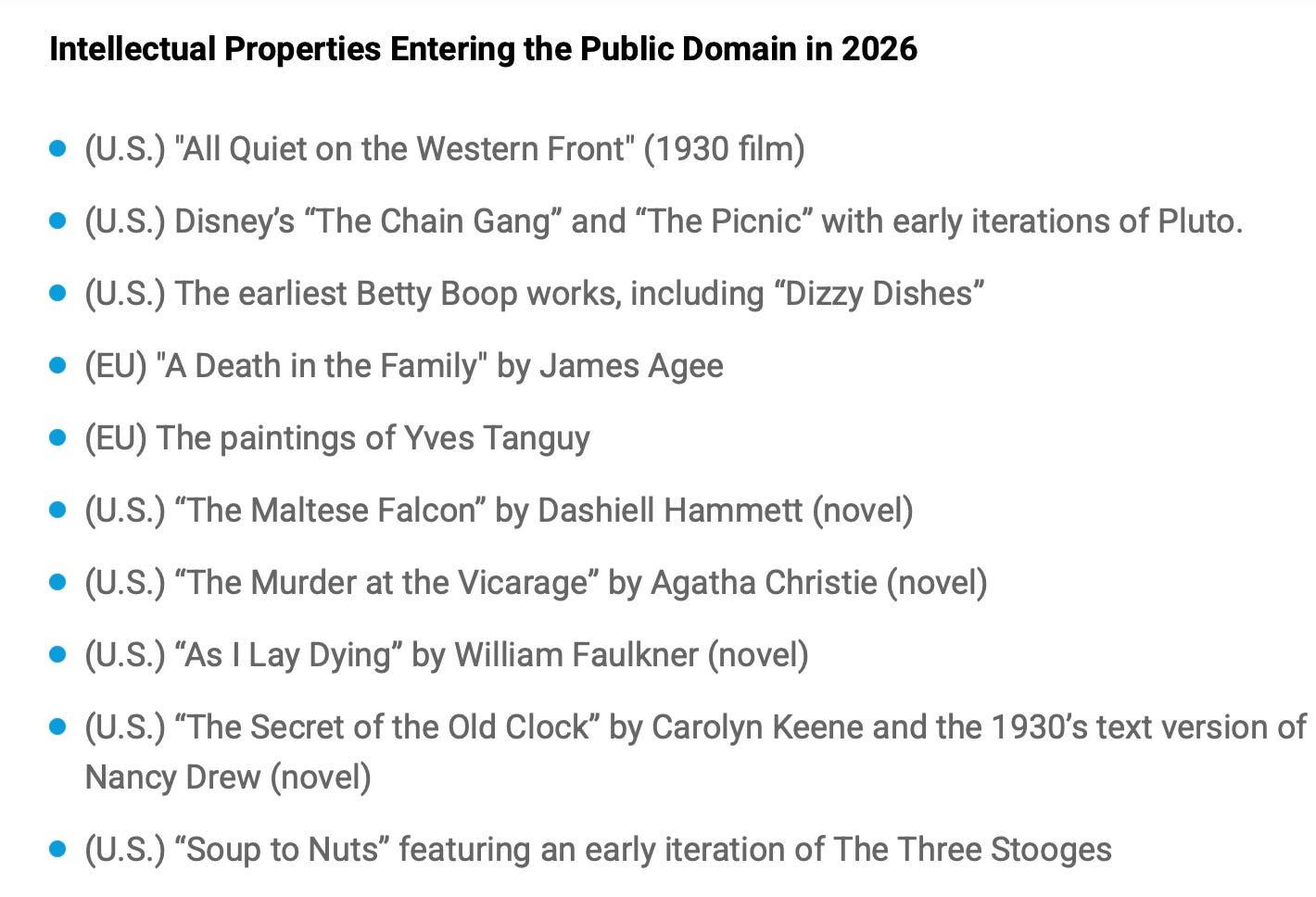
I think what I’m trying to do here is an end run around current conversations. Instead of debating American copyright laws as they pertain to AI companies and LLMs, I’m soothing myself by getting to better know more that it is free of such laws. What have we forgotten to remember? Which authors, or artists, or creative works of any sort are accessible to all, and could be, if found and displayed, interesting, edifying, and enlightening to Americans in 2025? What could we put into our own private LLMs—our brains1—to read or play with and create of them something new? I’d love to hear what free stuff you love, and think might find new audiences, while we otherwise debate who owns the creations of the more recent past.
Sorry that’s a terrible metaphor. Brains are not like computers. But it felt cute.
Tom Lehrer, a wonderful satirical song writer, and a retired math professor, put all of his music in the public domain when he recently died. Good for him!
Nancy Drew in the public domain is oddly exciting to me.