Introduction to American Made: Stories of Work from the WPA
Last call for my book proposal course.
On July 11 I’m hosting a webinar on what authors can expect from publishers, and how to build a strong and fun relationship with the folks with whom you are creating a book .
American Made: Stories of Work from the WPA publishes in two weeks (Bastille Day!). It’s my (ironic) contribution to America250. Below is the introduction*1I wrote. Get your copy of the book here or wherever books are sold.
In the spring of 2025, I was poking around on the Library of Congress website, looking at public domain images from the Works Progress Administration (WPA). I’ve been doing this for decades, during quiet late afternoons, browsing the archives that good folks have taken care to digitize and make available to anyone with a Wi-Fi connection—often along with information about copyright and licenses, which usually clarify that the works are in the public domain, because produced by the United States government, and thus free to be used as one might see fit. This time, I happened upon a collection I’d never seen before: a series of oral interviews done by writers on the federal payroll, hired as part of the WPA to chronicle American lives in the 1930s. This archive was part of the Federal Writers’ Project (FWP), a subset of the WPA, and the entire collection contains more than ten thousand first-person interviews with working Americans compiled in the late 1930s. Ten thousand individual stories: the size of a town. It is the largest collection of oral interviews in existence. The Library of Congress has digitized about 30 percent of the total collection, which adds up to thousands of interviews—about 2,900 total.
“Newsboys: Chicago,” one entry was titled, and clicking through, I read Philip Marcus explain how he made money selling papers on street corners when he was a child, how he avoided the bigger boys who might steal his money, and how he yelled “White House scandal!” to gin up business. “Meatpackers” startled and repelled me as Marge Paca discussed handling frozen brains. “Iron Workers” is similarly distressing, as Chris Thorsten casually describes workers killed while building New York City subway lines and the four years he spent in traction after his own workplace fall. Horrifying, yes, but also riveting: Marcus’s, Paca’s, and Thorsten’s words have a startling directness that also seems to frame an era. “When papers was a penny apiece was the days when I was selling them. I was a little lad then, and I lived on the streets practically all day, days and nights both. We used to sneak in the burlesque houses or the all-night places on West Madison Street and sleep there,” remembers the newsboy Marcus. Paca recalls, “I used to have to pack the brains in cans. They would be frozen stiff and my nails would lift right up off my fingers handling them. It’s always wet there and very, very cold. I had to wear two and three pairs of woolen stockings, two pairs of underwear, a couple of woolen skirts, and all the sweaters I had.”
The narratives are at once unique and representative, intimate and generalizable—through them, as through a novel, I glimpsed the ’30s, jobs, the immigrant experience, gender hierarchies, American inequality.
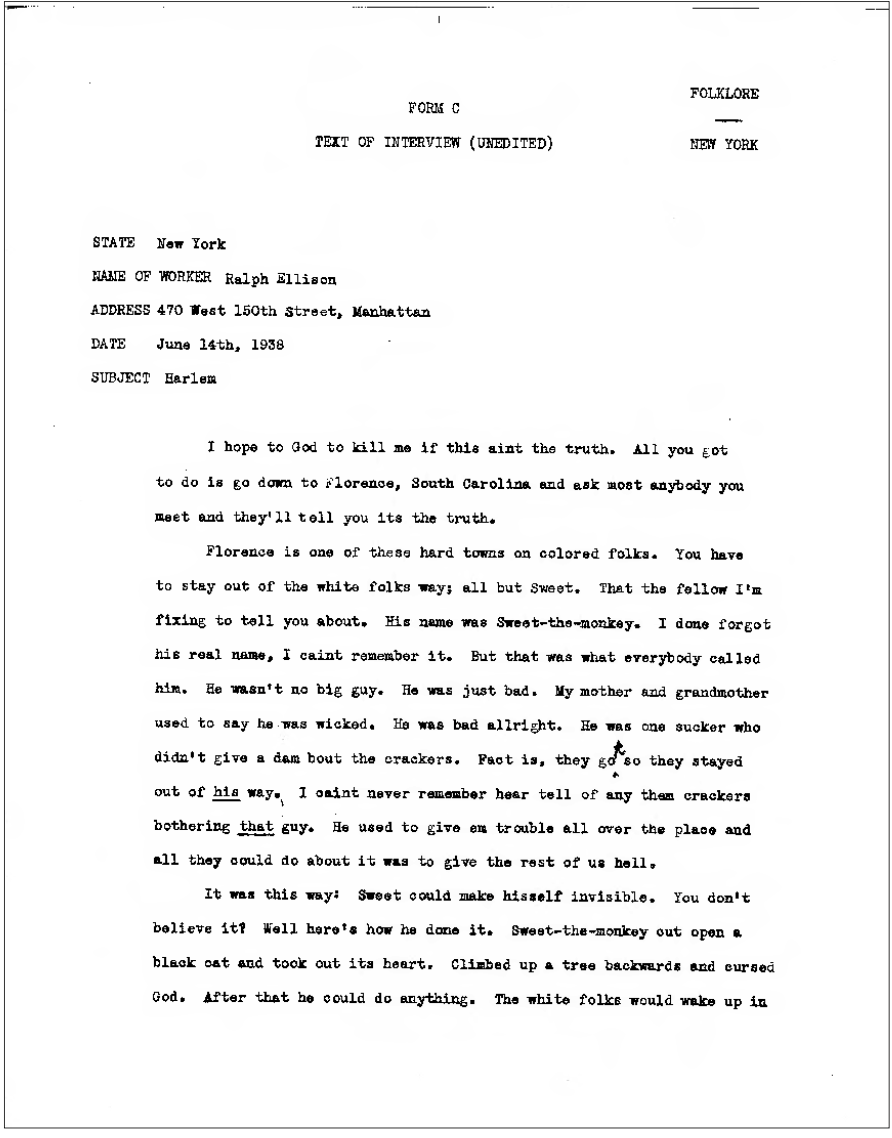
The archive is digitized but not transcribed, so you read it not in Times New Roman or an infinite scroll but via scans of the original typewritten, sometimes handwritten, pages. The pages are fascinating in and of themselves, material documents that convey their history: fading typewriter ribbons, marginal notes, and other residue of twentieth-century writing tools are integral to the experience of reading the archive online. We have included facsimilies of two of these interviews in the back of this book.
The collection is organized so you can navigate it variously, such as by state or city (New York, Charleston), occupation (mill worker, tavernkeeper, maid), or the interviewer’s name. Reading the interviews might remind you, as it did me, of the works of Studs Terkel, who was employed by the WPA, particularly the oral histories he collected in Hard Times: An Oral History of the Great Depression, published in 1970, and Working, published in 1974. For Hard Times, Terkel interviewed people in the 1960s about their experiences in the 1930s. The interviews in this book, as squinting at muddy letters on my laptop screen made clear and the accompanying notes by the writer/interviewers explain, were largely done in the moment—during that workday, over a break, or later that night, in a kitchen or the union hall. They are immediate.
Many readers may be familiar with another, better-known WPA project, the American Guide Series. Those guides were originally published in the 1930s and have been reprinted often since. But the material collected for this project, American Life Histories, was not published in the 1930s, or the ’40s, or ever at all. Most of it only exists in the Library of Congress, either digitized or physically, in the building itself. The collection was placed with the Library of Congress back in 1941, after funding was shut down, and was then largely forgotten. That the material has been since catalogued and made accessible is largely due to the writer Ann Banks, who discovered the archive and published selections in First-Person America, published by Knopf in 1980 and reissued by Norton in 1991. Banks brought the project to the public’s attention, researched its history, and interviewed many of the writers involved. Then many of us largely forgot about them again. So I decided to do my part to aid memory, with the United States’ 250th birthday coming up, and edit another sampler.
It was a wonderful rabbit hole to fall into—particularly in the spring and summer of 2025, when, as now, the news was crowded with calls for Americans to return to the sorts of jobs described in American Life Histories, factory jobs that have been since shut down, onshore manufacturing positions lost to offshoring decades earlier. Let’s bring back American industry, good old blue-collar American jobs, representatives of the current administration would tell reporters on the Sunday news shows. Honest work is good, they said of Medicaid cuts. Americans should once again do the jobs that immigrants are now doing.
Well, I thought, here are testimonials about what those jobs were like, given when the workers were employed in such jobs. What could they tell us about these now scarcer forms of employment some are calling to restore?
The most obvious parallel is that many of the interviews are with first-generation immigrants. It’s the same story with different flags: Polish, German, Russian, Irish, Italian, Hungarian, Slovakian. Workplaces were often defined by the dominantethnicities of the workers. For many of the people interviewed, their jobs and their ethnicities formed overlapping identities: I’m a Polish meatpacker, a Portuguese fisherman, a French Canadian textile worker. Race, of course, also determined occupation: Black workers sorted the tobacco or were tenant farmers, while white workers were the tobacco auctioneers or landlords.
Unsurprisingly, then as now, working conditions were described as dangerous, grueling, inhumane. Wages were not enough to feed a family. The most common solution suggested by workers was unions; that many of the interviews took place in union halls skews the survey, but the felt truth of how workers described their conditions, and the improvements unions brought to workplaces, is undeniable. Thankfully, many labor laws were subsequently passed outlawing such conditions, so a similar set of interviews today might contain fewer severed digits—but likely just as many long hours, fears of unemployment, and bosses scheming to squeeze the most labor from struggling immigrants living in tiny quarters, entire families sharing one bed.
The goal of this branch of the Federal Writers’ Project was to publish a series of books. They would be anthologies of interviews organized by occupation, region, and ethnic groups. This was indeed the result of the American Guide Series portion of the FWP, and many books were published during the lifetime of the project: California: Guide to the Golden State in 1939, New York: A Guide to the Empire State in 1940. But there was another goal, to collect the contemporary folklore of everyday Americans, and that is what this archive consists of. No books were published from it by the WPA, because the New Deal program became a flashpoint for conservatives in Congress and elsewhere. They attacked the WPA, claiming it to be a hotbed of radicalism, full of “communistic activity.” One of the first targets of the House Un-American Activities Committee (HUAC), formed in 1938, was the WPA, and the committee successfully persuaded Congress to shut it down (in 1939, Congress would also pass the Hatch Act, limiting political activities by federal workers, as a way to undercut the WPA). Funding was canceled—more shadows of our contemporary moment, which has seen funding for similar programs of the 1960s-founded National Endowment for the Humanities and National Endowment for the Arts axed by the Trump administration. World War II ended any hope of eventually reviving it.
So those ten thousand interviews, completed and typed up with those loose, faded ribbons, were sent to the Library of Congress in 1941. Many—most—of the writers and workers never saw the results of their work in any form. Then Banks started paging through the files and interviewing some of the then-living writers. She talked to Ralph Ellison, Harold Rosenberg, May Swenson, Betty Burke, Jack Conroy, Stetson Kennedy, and others, and she integrated her interviews with the interviewers into her introduction to First- Person America.
Many of the writers were just as poor as the workers they interviewed, and the work they did helped them feed their families, too: It was a relief program for writers, who had to pass a means test to get hired. “Actually to be paid for writing … Why that was a wonderful thing!” remembered Ellison. Other now- famous names who were involved include Saul Bellow, John Cheever, Conrad Aiken, Nelson Algren, Jack Conroy, and Muriel Rukeyser. Many interviewers are lesser known, but read the first-person accounts they typed up and you start to appreciate their skills. Betty Burke, for instance, seemed to get the most poignant and concise words from the largely female meatpacking workers she met with in cramped Chicago apartments. (For the purposes of this introduction, workers refers to people being interviewed, and interviewer refers to the writers. In the interviews themselves, worker usually refers to the writer and informant to the person being interviewed; it can be confusing.)
These skills were imparted to the interviewers by the program’s leaders, who urged them to highlight “democratic and progressive folk consciousness” and separate that from the “regressive folk dogma of the racialists and nationalists.”* The program heads hoped the published interviews would help stave off European fascism; as Rabbi Stephen Wise, who helped train writers, put it, they would “publish material sympathetic to ethnic diversity as a way of preventing European hatreds from infecting our own country.” That never happened then—the interviews all remained unpublished—but perhaps they could still prove useful for similar ends.
The experiences and biographies of the writer/interviewers in the project are certainly as fascinating as those of the interviewed workers. And although many of the writers are not known to us now, many others got their start thanks to the program, including four of the first ten winners of the National Book Award.* In her introduction to the revised edition of First-Person America, Banks notes how excited the writers were to finally see their work published and the attention this brought, in some cases, to their other works. Those interested in learning more about the writers involved could read David Taylor’s Soul of a People: The WPA Writers’ Project Uncovers Depression America. But to focus too much on the writers—particularly those whose names we recognize today—would be to do an injustice to the project. The workers—the lives they lived, the stories they tell—should receive top billing and our full attention.
The more time I spent with the collection, the more extraordinary I found the editor of the project, Benjamin Botkin. Botkin took over the folklore project from John Lomax (father of Alan), famed for his collections of ballads and cowboy songs. Botkin’s approach underlay how the materials were gathered, who would be interviewed, and how the interviews should proceed. Botkin, the son of Russian Jewish immigrants, grew up in Boston and was educated at Harvard, Columbia, and the University of Nebraska.
A folklorist by training, he became an English professor at the University of Oklahoma, where he published the first book by the University of Oklahoma Press, a collection of folklore, and edited a journal, Folk-Say. Botkin, controversial at the time, upended views on folklore; he modernized the field by shifting the emphasis from rural tall tales to urban working life. He looked on new immigrants not as ingredients to be melted, as the metaphor has it, but “components of ‘composite America’ who participated in our cultural diversity.” His folklore department would provide a “comprehensive picture of how America lives and works and plays,” so that the nation would be able to hear the voices of Americans “who otherwise might not have left a record.”* Under Botkin, folklore—which is how he would describe the essays in this book—would not just entertain; it would also ameliorate people’s material conditions and the Depression-era emotional wounds of the nation.
The work of collecting folklore would help American writers and writing, too: Botkin felt novels would be better if their writers gathered stories from those otherwise unheard and considered themselves alongside, rather than above or removed from, the people they interviewed. Botkin believed the experience would provide a “social and cultural consciousness too often lacking in ivory-tower writing,” as novelists would bring “the streets, the stockyards, and the hiring halls into literature.” It would make for better folklore, too. He told his writers/interviewers to have beers with the workers, say, instead of arranging a meeting across a desk: “You have to pass the time of day with them until you reach the point where you feel a warm relationship so that you can talk, so that they can talk.”* Ralph Ellison took his advice: “I hung around playgrounds; I hung around the street, the bars. Sometimes you would find people sitting around on Eighth Avenue just dying to talk.” (Ellison’s transcript of such a man talking on that street is included in this collection.)
Many of the writers interviewed people with similar backgrounds, including Hilda Polachek, whose memoir I Came a Stranger: The Story of a Hull-House Girl was published in 1989. She was a Polish Jewish immigrant living in Chicago; broke and supporting two children by herself, she waited outside the WPA offices every day for a month before she was finally hired. Her interview with Louis Tecotzky, another Polish Jewish immigrant, who told her about escaping Poland through Cuba to the United States to become a fishmonger, is included in this book.
Some of the words in the transcripts are objectionable today and may have been to the transcribers at the time. That’s OK, Botkin said. If they disagreed with a worker, they should not intervene, so they could represent a “living culture and … democratic society as a whole” and “discover the real feeling of the person consulted… regardless of his own attitude toward it.”† As a result of this and other methods, the stories elicited, which the writers transcribed—the stories of the “folk”—are worthy of literary acclaim in and of themselves. “Folk literature differs from the rest of literature only in its history; its author is the original ‘forgotten man,’” as Botkin wrote in his Treasury of American Folklore, published in 1944.
When deciding which of the narratives to include in this book—a sampler, aimed at whetting appetites to delve further—my process was relatively straightforward. I chose the interviews, condensing some, I felt would most resonate with readers today, particularly while the nation celebrates its 250th birthday, and were the best examples of their genre, with engaging voices or interesting details about jobs that no longer exist. I sought to include a representative slice of jobs, geographies, ethnicities, and races, though the collection itself skews heavily toward some rather than others: Chicago is overrepresented, and anyplace west of that city is harder to find. And, of course, I took the editor’s prerogative to play favorites, picking a few simply because I kept coming back to them myself, such as the Portuguese fisherman from Cape Cod or the female meatpacking workers from whom interviewer Betty Burke seemed to elicit such vivid, if horrifying, anecdotes from the factory floor. And who could resist the story of the man who turned himself invisible, recorded by Ralph Ellison?
I hope you find these interviews—which we could also call essays, memoirs, testimonials, literary works—as fascinating and evocative as I did. We have United States government workers to thank for their existence, for compensating the writers involved, and for digitizing the collection. And we have so much yet to learn.
Apologies in advance for any PDF-converted formatting problems.